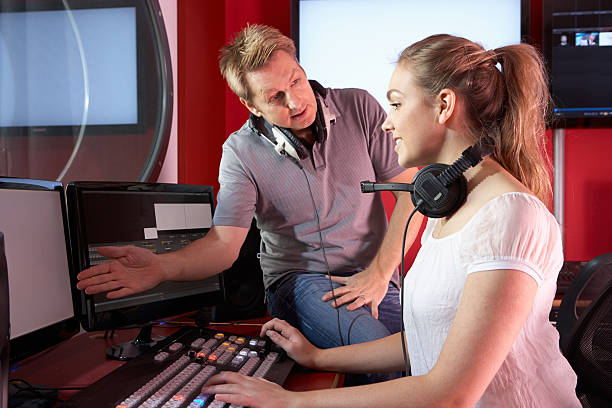
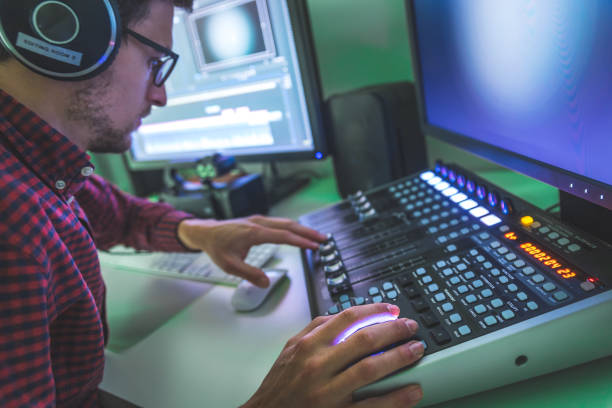
Audio & Video Technologists are technical experts responsible for recording, editing, mixing, and optimizing audio and video content to meet industry standards and creative visions. Their role includes operating specialized equipment, troubleshooting technical issues, and ensuring synchronization of sound and visuals across diverse projects, ranging from movies to live broadcasts. They combine technical proficiency with an understanding of media production, working across various settings to enhance audience engagement. As key contributors to the media and entertainment industries, Audio & Video Technologists drive quality and innovation in a landscape increasingly focused on high-definition and immersive experiences.
- Audio Recording and Editing
- Capture high-quality sound using microphones, recorders, and other audio equipment.
- Edit audio tracks to remove noise, balance levels, and add effects as needed.
- Video Recording and Editing
- Operate cameras, lighting, and other video equipment to record footage.
- Edit video content for clarity, pacing, and visual impact using specialized software.
- Equipment Setup and Maintenance
- Set up and calibrate audio and video equipment for recordings or live events.
- Perform regular maintenance and troubleshooting to ensure optimal performance.
- Sound Design and Mixing
- Create and mix soundscapes, including dialogue, music, and effects, for media projects.
- Ensure audio aligns with visual elements for a cohesive experience.
- Live Event Support
- Manage audio and video systems during live broadcasts, concerts, or conferences.
- Monitor and adjust sound and visuals in real-time to maintain quality.
- Post-Production Integration
- Synchronize audio and video elements during post-production for seamless output.
- Collaborate with editors and directors to refine audiovisual content.
- Technical Problem Solving
- Identify and resolve technical issues related to audio and video equipment or software.
- Adapt to on-set challenges to ensure production continuity.
- Research and Innovation
- Stay updated on advancements in audio and video technology to improve workflows.
- Experiment with new tools or techniques to enhance production quality.
| Route | Steps |
| Route 1 | 1. 10+2 in any stream (preferably with Physics or Media subjects) |
| 2. Bachelor’s degree in Audio-Visual Technology, Media Production, or related field (3-4 years) | |
| 3. Internship or practical training (3-6 months) | |
| 4. Practice as Junior Audio & Video Technologist | |
| Route 2 | 1. 10+2 in any stream |
| 2. Diploma or Certificate in Audio-Visual Technology or Sound Engineering (6 months-2 years) | |
| 3. Build hands-on experience through projects | |
| 4. Work as Freelance or Junior Audio & Video Technologist | |
| Route 3 | 1. 10+2 in any stream |
| 2. Bachelor’s degree in Media Technology or Film Production (3-4 years) | |
| 3. Master’s degree in Audio-Visual Technology or related field (2 years) | |
| 4. Work as Senior Audio & Video Technologist or Supervisor | |
| Route 4 | 1. 10+2 in any stream |
| 2. Advanced international training or certification in Audio-Visual Technology (1-2 years) | |
| 3. Master’s or specialized courses as per country requirements | |
| 4. Practice abroad or in India |
- Mandatory practical training during degree or diploma programs in studios or production houses.
- Rotations in media companies for hands-on experience with real-world projects.
- Internships under senior technologists for exposure to professional workflows.
- Observerships in film or broadcast studios for experience in audio-visual pipelines.
- Participation in mock projects or live events for practical skill development.
- Training in collaborative projects through real-world client briefs or productions.
- Exposure to industry-standard equipment and software during internships.
- Project-based learning focusing on diverse audio and video production techniques.
- Public outreach initiatives like assisting in community media or educational content.
- International attachments or online collaborations for global exposure to audio-visual practices.
- Certificate in Sound Engineering or Video Editing.
- Bachelor’s in Audio-Visual Technology, Media Production, or Film Studies.
- Master’s in Media Technology or Digital Production.
- Specialization in Audio Mixing and Mastering.
- Certification in Broadcast Technology.
- Workshops on Digital Audio Workstations (DAWs) and Video Editing Software.
- Training in Live Sound Reinforcement.
- Specialization in Cinematography Technology.
- Certification in Post-Production Techniques.
- Short Courses in Virtual Production and Streaming Technology.
| Institute | Course/Program | Official Link |
| Film and Television Institute of India (FTII), Pune | Diploma in Sound Recording and Design | https://www.ftii.ac.in/ |
| Satyajit Ray Film & Television Institute (SRFTI), Kolkata | Diploma in Sound Recording and Audiography | https://srfti.ac.in/ |
| Whistling Woods International, Mumbai | B.A. in Filmmaking with Sound Specialization | https://www.whistlingwoods.net/ |
| Annapurna College of Film and Media, Hyderabad | Diploma in Audio-Visual Technology | https://www.annapurnacollege.edu.in/ |
| Zee Institute of Media Arts (ZIMA), Mumbai | Diploma in Sound Engineering | https://www.zimainstitute.com/ |
| Digital Academy - The Film School, Mumbai | Certificate in Sound Design and Recording | https://www.dafilmschool.com/ |
| LV Prasad Film & TV Academy, Chennai | Diploma in Sound Technology | https://www.prasadacademy.com/ |
| Arena Animation, Multiple Locations | Diploma in Audio-Visual Editing | https://www.arena-multimedia.com/ |
| MAAC (Maya Academy of Advanced Cinematics) | Certificate in Audio-Visual Production | https://www.maacindia.com/ |
| Symbiosis Institute of Media & Communication, Pune | B.A. in Audio-Visual Production | https://www.simc.edu/ |
| Institution | Course | Country | Official Link |
| New York University (NYU) Tisch School of the Arts | BFA/MFA in Film and Television Production | USA | https://tisch.nyu.edu/ |
| University of Southern California (USC) School of Cinematic Arts | BFA/MA in Film Production Technology | USA | https://cinema.usc.edu/ |
| National Film and Television School (NFTS) | MA in Sound Design for Film and TV | UK | https://nfts.co.uk/ |
| Ryerson University | BFA in Media Production | Canada | https://www.ryerson.ca/ |
| Australian Film, Television and Radio School (AFTRS) | Graduate Diploma in Sound | Australia | https://www.aftrs.edu.au/ |
| Vancouver Film School (VFS) | Sound Design for Visual Media Program | Canada | https://vfs.edu/ |
| Berklee College of Music | B.M. in Film Scoring and Sound Design | USA | https://www.berklee.edu/ |
| Royal College of Art (RCA) | MA in Digital Direction (Audio-Visual) | UK | https://www.rca.ac.uk/ |
| Tokyo University of the Arts | Media Technology Programs | Japan | https://www.geidai.ac.jp/ |
| Nanyang Technological University (NTU) | Media Production Programs | Singapore | https://www.ntu.edu.sg/ |
India:
- FTII Entrance Exam: Conducted by the Film and Television Institute of India for admission to audio-visual and sound programs.
- SRFTI JET (Joint Entrance Test): For admission to sound recording and audiography programs at Satyajit Ray Film & Television Institute.
- Whistling Woods Entrance Test (WWIET): Required for admission to filmmaking and audio-visual courses.
- Symbiosis Entrance Test (SET): For admission to media and communication programs at Symbiosis Institute.
International:
- SAT (Scholastic Aptitude Test): Required for undergraduate media programs in countries like the USA.
- TOEFL (Test of English as a Foreign Language): Minimum score of 80-100 required for non-native speakers applying to programs in English-speaking countries.
- IELTS (International English Language Testing System): Minimum score of 6.0-7.0 required for admission to universities in the UK, Australia, and other English-speaking regions.
- PTE Academic (Pearson Test of English Academic): Accepted by many international institutes as an alternative to TOEFL or IELTS for English proficiency.
- Duolingo English Test: Accepted by some institutions as a convenient alternative for English language proficiency testing.
Junior Audio & Video Technologist → Senior Audio & Video Technologist → Audio-Visual Supervisor → Technical Director → Production Manager → Audio-Visual Consultant → Studio Technical Head → Media Technology Innovator
- Film and television production houses for audio-visual content creation.
- Live event companies for managing sound and video during concerts and conferences.
- Broadcast media for television and radio production support.
- Digital content platforms for web series, podcasts, and streaming media.
- Gaming industry for audio and video integration in interactive media.
- Advertising agencies for creating high-quality commercials and campaigns.
- Corporate sector for training videos and internal communications.
- Educational institutions for e-learning content and multimedia production.
- Freelance opportunities for independent audio-visual projects.
- Government and NGOs for public awareness campaigns and documentation.
| India | International |
| Yash Raj Films | Warner Bros. Entertainment, USA |
| Dharma Productions | Universal Studios, USA |
| Red Chillies Entertainment | BBC (British Broadcasting Corporation), UK |
| Eros International | Netflix, USA |
| Zee Entertainment Enterprises | Disney Media & Entertainment, USA |
| Sony Pictures Networks India | Sony Pictures Entertainment, USA |
| Star India | Paramount Global, USA |
| Viacom18 Media | NBCUniversal, USA |
| Balaji Telefilms | Spotify Technology, Sweden |
| Reliance MediaWorks | Apple (Apple TV+), USA |
| Pros | Cons |
| Opportunity to work on diverse and creative media projects | High-pressure environment due to tight production deadlines |
| High demand for technologists in film, broadcast, and digital media | Long and irregular hours, especially during live events or shoots |
| Rewarding impact through delivering high-quality audiovisual experiences | Risk of physical strain from handling heavy equipment or prolonged work |
| Diverse career paths across entertainment, corporate, and live events | Limited job security in freelance or contract-based roles |
| Strong potential for growth with advancements in media technology | Dependency on client feedback and frequent technical revisions |
- Growing integration of AI and automation in audio-visual production workflows.
- Rising demand for technologists due to the expansion of streaming and digital platforms.
- Advancements in immersive audio technologies like Dolby Atmos for enhanced experiences.
- Heightened focus on high-definition and 4K/8K video production standards.
- Expansion of virtual production techniques for real-time audio-visual integration.
- Development of sustainable production practices through energy-efficient equipment.
- Increased emphasis on cloud-based editing and remote collaboration tools.
- Enhanced collaboration between technologists and content creators for innovative projects.
- Growing need for continuous training to master emerging media technologies.
- Focus on global production standards to align audio-visual practices internationally.
| Career Level | India (₹ per annum) | International (USD per annum) |
| Junior Audio & Video Technologist (Early Career) | 2,50,000 - 4,50,000 | 30,000 - 45,000 |
| Senior Audio & Video Technologist (Mid-Career) | 4,50,000 - 7,50,000 | 45,000 - 65,000 |
| Audio-Visual Supervisor | 7,50,000 - 10,00,000 | 65,000 - 85,000 |
| Technical Director/Production Manager | 10,00,000 - 15,00,000 | 85,000 - 110,000 |
| Studio Technical Head/Consultant | 15,00,000+ | 110,000+ |
Note: Salaries vary based on location, experience, employer, and specialization. International figures are approximate and depend on the country and sector.
- Digital Audio Workstations (DAWs) for sound editing (e.g., Pro Tools, Audacity).
- Video Editing Software like Adobe Premiere Pro or Final Cut Pro for post-production.
- Audio Mixing Tools like Avid or Logic Pro for sound design.
- Live Streaming Software like OBS Studio for real-time broadcasts.
- Media Encoding Tools for format conversion and playback optimization.
- Teleconferencing tools like Zoom for remote collaboration and client meetings.
- Asset Management Systems for organizing audio and video files.
- Microsoft Office Suite for documentation and project planning.
- Virtual Production Tools like Unreal Engine for real-time integration.
- Project management tools like Trello for coordinating production timelines.
- Audio Engineering Society (AES), Global.
- Society of Motion Picture and Television Engineers (SMPTE), USA.
- Indian Film & Television Directors’ Association (IFTDA), India.
- International Sound & Video Professionals Association (ISVPA).
- Broadcast Engineering Society (BES), India.
- European Broadcasting Union (EBU), Europe.
- National Association of Broadcasters (NAB), USA.
- Indian Broadcasting & Digital Foundation (IBDF), India.
- Women in Film & Television (WIFT), Global.
- Media & Entertainment Skills Council (MESC), India.
- George Lucas (Historical, USA): Pioneer in film technology since the 1970s through Lucasfilm and THX. His innovations in sound and visual effects set industry standards for cinematic experiences. His work on "Star Wars" redefined audio-visual integration. His contributions impact media technology globally.
- Ray Dolby (Historical, USA): Founder of Dolby Laboratories since the 1960s. His development of noise reduction and surround sound systems like Dolby Atmos revolutionized audio technology. His innovations remain a cornerstone of modern sound design. His legacy influences audio production worldwide.
- ResulPookutty (Contemporary, India): Oscar-winning sound designer since the 2000s, known for "Slumdog Millionaire." His expertise in sound mixing elevates Indian cinema on the global stage. His work bridges cultural narratives with technical excellence. His impact strengthens audio technology in India and beyond.
- Walter Murch (Contemporary, USA): Renowned film editor and sound designer since the 1970s. His work on "Apocalypse Now" pioneered modern sound editing techniques. His contributions to audio-visual storytelling are widely studied. His innovations shape media production globally.
- BishwadeepChatterjee (Contemporary, India): Award-winning sound designer since the 1990s, known for films like "3 Idiots." His meticulous audio work enhances the cinematic experience in Indian films. His collaborations set benchmarks for sound quality. His impact resonates in the national film industry.
- Gary Rydstrom (Contemporary, USA): Sound designer at Pixar and Skywalker Sound since the 1980s. His work on "Jurassic Park" and "Toy Story" redefined audio in animation and film. His innovations in sound effects are industry-defining. His contributions advance audio technology internationally.
- NakulKamte (Contemporary, India): Sound designer since the 2000s, known for films like "Lagaan." His expertise in capturing authentic soundscapes elevates storytelling in Indian cinema. His technical precision inspires upcoming technologists. His work impacts the industry nationally.
- Anish John (Contemporary, India): Sound engineer since the 2010s, recognized for films like "Trapped." His innovative approaches to sound design create immersive auditory experiences in Indian cinema. His contributions highlight the importance of audio in storytelling. His impact strengthens Indian media production.
- Ben Burtt (Contemporary, USA): Sound designer since the 1970s, known for creating iconic sounds in "Star Wars." His pioneering work in sound effects shaped modern cinema audio. His creativity continues to inspire technologists. His contributions influence global audio design.
- Skip Lievsay (Contemporary, USA): Sound mixer and designer since the 1980s, known for collaborations with the Coen Brothers. His work on films like "No Country for Old Men" exemplifies audio storytelling. His technical mastery sets industry standards. His impact drives audio innovation worldwide.
- Build a strong foundation in audio and video systems to understand media production.
- Seek early exposure to production environments through internships to confirm interest in the field.
- Prepare thoroughly for entrance exams or certification requirements specific to your chosen program or region.
- Pursue advanced certifications in sound engineering or video editing to gain expertise.
- Stay updated on advancements in audio-visual technology by attending workshops and conferences.
- Develop hands-on skills in equipment operation through practical project work.
- Engage in short film or event production projects to build real-world experience.
- Join professional associations like the Audio Engineering Society (AES) for networking and resources.
- Work on precision and technical thinking to ensure high-quality audio-visual output.
- Explore international media programs for exposure to diverse production styles and standards.
- Volunteer in studios or live events to understand industry challenges and build experience.
- Cultivate adaptability to handle complex technical and logistical challenges.
- Attend continuing education programs to stay abreast of evolving media technologies.
- Build a network with technologists, producers, and industry professionals for collaborative efforts.
- Develop resilience to manage the technical and deadline demands of production work.
- Balance project work with continuous learning to adapt to rapid advancements in media technology.
A career as an Audio & Video Technologist offers a unique opportunity to contribute to entertainment, communication, and digital innovation by creating high-quality audiovisual experiences. From enhancing cinematic soundscapes to ensuring flawless live broadcasts, Audio & Video Technologists play a pivotal role in modern media and technology. This field combines technical expertise, problem-solving skills, and a commitment to engaging audiences, offering diverse paths in film, broadcast, events, and beyond. For those passionate about media production, adapting to technological trends, and addressing technical challenges in an era of rapid digital evolution, a career as an Audio & Video Technologist provides an intellectually stimulating and professionally rewarding journey with the potential to make significant contributions to society by advancing the art and application of audio-visual technology worldwide.