
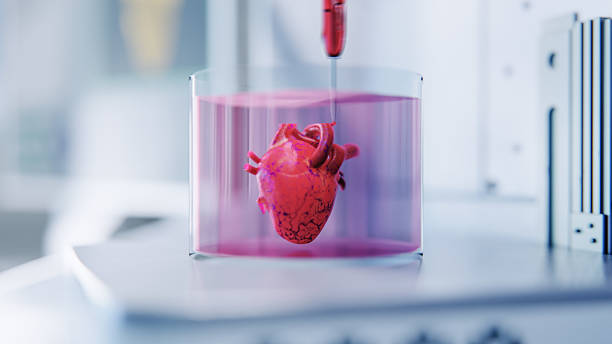
Imagine a world where, if someone’s heart, liver, or skin was damaged, we didn't have to wait for a donor organ or suffer through years of difficult treatment. Instead, we could just "print" a new one using the patient’s own cells.
This isn't a plot from a futuristic movie—it is the cutting-edge reality of Regenerative Medicine.
Regenerative medicine is a revolutionary branch of science that focuses on replacing or "regenerating" human cells, tissues, and organs to restore normal function. It is moving us away from simply treating symptoms to actually repairing the human body from the inside out.
How Do You Actually "Grow" an Organ?
Growing an organ is a lot more complex than just putting cells in a petri dish and waiting. It requires a three-part "blueprint" that scientists follow to build living tissue:
- The Scaffolding: Think of this as the "frame" of a house. Scientists create a 3D-printed structure made of biodegradable materials that mimics the shape and structure of the organ they want to build.
- The Cells: They take a small sample of a patient's own cells (like skin or blood cells) and use "reprogramming" technology to turn them into stem cells. These are "blank slate" cells that can be trained to become whatever type of tissue is needed—like muscle for a heart or neurons for a brain.
- The Bio-Ink: Scientists mix these trained cells into a nutrient-rich "bio-ink" and use a 3D bioprinter to place them onto the scaffold. Once the cells are in place, they start to grow, connect, and eventually form functional, living tissue.
Why This Changes Everything
Current medicine is often about "patching" holes. If your kidney fails, you might need a transplant, but your body often treats donor organs as "foreign," leading to a lifetime of anti-rejection medication.
Regenerative medicine is a game-changer because:
- Zero Rejection: Because the organs are grown from your own cells, your body recognizes them as "you" and doesn't try to fight them off.
- Ending the Waitlist: Millions of people are currently waiting for organ transplants. If we can grow them in a lab, we can end the shortage forever.
- Supercharged Healing: Instead of just healing a wound with a scar, regenerative medicine aims to regrow the original tissue perfectly, meaning no more permanent damage from accidents or diseases.
Your Career Path: How to Join the Bio-Revolution
If you love biology, coding, and solving massive, world-changing problems, this field is arguably the most exciting place to be. Here is the path you can take to become a leader in regenerative medicine:
Step 1: The High School Foundation
- Focus on STEM: Take AP Biology, Chemistry, and Physics.
- Computer Science: Don't skip the coding! Modern regenerative medicine is heavily reliant on data analysis and AI-driven modeling to understand how cells grow.
- Ethics: Take courses in philosophy or ethics. You will be dealing with the question of "what defines life," so understanding the ethics of biotech is a crucial skill for any future researcher.
Step 2: Undergraduate Majors
- Bioengineering / Biomedical Engineering: This is the best path for building the hardware (like 3D bioprinters) and the scaffolding systems.
- Molecular Biology / Genetics: If you want to be the person who understands the code of life—how to train stem cells and edit DNA—this is your degree.
- Computational Biology / Bioinformatics: If you prefer working with the data, algorithms, and AI models that simulate how tissues grow, this is a fast-growing, high-demand path.
Step 3: Getting Your Hands Dirty
- Lab Internships: Look for "Research Experience for Undergraduates" (REU) programs during your college summers.
- Join iGEM: If your university has an iGEM (International Genetically Engineered Machine) team, join it immediately. It’s a massive global competition where student teams build genetic engineering projects from scratch. It is the gold standard for landing biotech jobs.
Is This Too Good to Be True?
It’s not magic—it's very hard science. We are still years away from "printing" a fully functional heart that can be used in surgery. The current challenges are about vascularization—basically, figuring out how to build the tiny, complex network of blood vessels that keep an organ alive.
But every year, the gap between what we can do and what we imagine gets smaller. The generation in high school right now will be the ones who actually move this tech from the research lab into the hospital.