
When a catastrophic earthquake strikes, a conflict breaks out, or a massive flood cuts off an entire region, public attention naturally goes straight to the heroes on the ground: doctors treating patients in makeshift tents and search-and-rescue teams digging through rubble.
But behind those front-line operations sits an invisible, hyper-complex network running 24/7. Without it, those doctors would run out of bandages in an hour, and rescue teams wouldn't have fuel for their vehicles.
Welcome to the world of Humanitarian Logistics—the high-stakes science of getting life-saving food, clean water, medicine, and shelter into the middle of active crisis zones.
What Makes Humanitarian Logistics Different?
If you order a hoodie online, a massive commercial logistics network kicks into gear. Companies like Amazon or FedEx use predictable highways, well-lit warehouses, and automated flight paths to drop that package at your door within two days. It is efficient because everything is stable.
Humanitarian logistics is the exact opposite. It operates in environments where everything has completely collapsed.
In a disaster zone:
- The electric grid might be entirely dark.
- The roads could be completely washed away or blocked by military forces.
- Communication lines are often down.
- The demand spikes from zero to millions of units of supply within a matter of hours.
Because of this, humanitarian logisticians can't rely on normal supply chain playbooks. They have to build custom networks on the fly using a three-phase approach.
The Three Strategic Phases of Aid Delivery
To manage the chaos of a sudden disaster, international aid agencies—like the United Nations World Food Programme or Doctors Without Borders—break down their supply chain strategy into clear milestones.
1. Pre-Positioning (The Ultimate Guessing Game)
You cannot wait for a hurricane to form to start buying blankets and water filters. Logisticians use predictive data and historical weather models to store millions of dollars worth of emergency supplies in global strategic hubs (like Dubai, Panama, or Brindisi) ahead of time.
2. The Bottleneck: Strategic Sorting
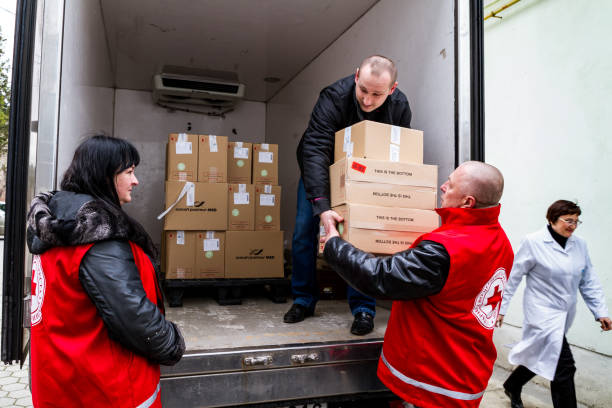
Once a crisis hits, the global hubs stream massive cargo planes directly toward the nearest functioning airport or seaport outside the disaster zone. This becomes a staging area. In these warehouses, items are sorted down to the individual kit level so they can be easily distributed without wasting a single second on the ground.
3. The Last Mile (Where the Real Puzzle Begins)
The "Last Mile" is the final, most dangerous leg of the journey—moving supplies from the local staging warehouse directly into the hands of the people who need them. If a bridge is collapsed, the last mile might involve using fleets of all-terrain trucks, loading supplies onto pack animals, or deploying cargo drones to drop medical packages into remote mountain villages.
The Core Math: Balancing the Trade-Offs
At its heart, managing a crisis supply chain is a mathematical balancing act. Every decision requires weighing immediate human speed against the physical limitations of weight, volume, and cost. Logisticians often use basic calculations to determine transport efficiency:
$$\text{Efficiency Metric} = \frac{\text{Total Cargo Volume (cubic meters)}}{\text{Total Transit Time (hours)}} \times \text{Urgency Factor}$$
Let's look at how choosing a transport vehicle changes the strategy completely:
| Transportation Mode | Speed | Payload Capacity | Infrastructure Needed | Cost Per Kilogram |
|---|---|---|---|---|
| Cargo Aircraft | Extremely Fast (Hours) | Medium | Requires an intact, long runway and functioning air traffic control. | Very High |
| Ocean Freight / Ships | Slow (Weeks) | Massive | Requires a deep-water port and heavy cranes to unload cargo containers. | Low |
| All-Terrain Trucks | Variable (Days) | Low to Medium | Can navigate broken roads, but vulnerable to mudslides or security roadblocks. | Medium |
How to Explore Humanitarian Supply Chains in High School
If you love looking at maps, solving logic puzzles, analyzing complex data, or managing fast-paced events, this branch of operations engineering might be your calling. You can start building relevant skills right now:
- Take AP/IB Statistics or Operations Math: Supply chains are driven entirely by numbers. Learning how to manage data sets, calculate probabilities, and predict trends will give you a major head start.
- Volunteer for Local Donation Drives: The next time your school or community hosts a food or clothing drive, don't just donate an item—volunteer to run the backend. Watch how items are collected, sorted, labeled, and shipped. Try to spot the bottlenecks: Where did the boxes pile up? How could the sorting line move faster? That is real-world logistics experience.
- Learn a Second Language: Humanitarian work is fundamentally global. Being able to communicate across cultures and navigate international international borders is just as important as being able to code a spreadsheet tracking inventory.
Technology can design the world's best medical treatments and agricultural solutions, but those innovations mean absolutely nothing if they are sitting in a warehouse five thousand miles away from the people fighting to survive. Humanitarian logisticians are the physical engine of global empathy, ensuring that when the world promises to help, the help actually arrives.